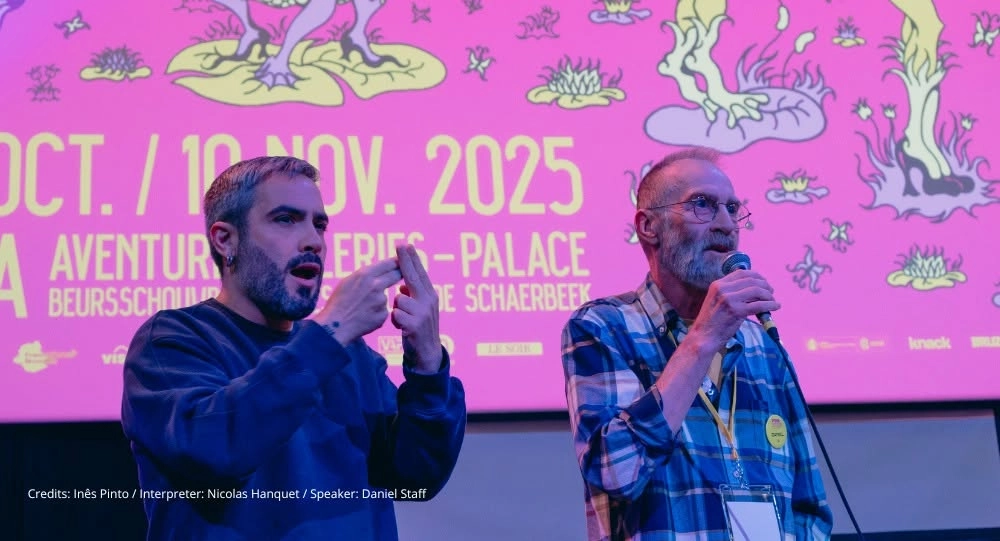
Discussion: towards accessible queer cinema
→ 21:30
39 rue Adolphe Lavallée, 1080 Molenbeek-Saint-Jean - Molenbeek-Saint-Jean
NL
De Brusselse queer cultuur moet het vaak met beperkte middelen stellen. Dat zorgt voor een verdere marginalisering van personen met een handicap en dikke personen. Hoe kunnen we het beter doen?
Beschrijving
In de huidige sociaaleconomische en politieke context heeft de Brusselse queer cultuur het moeilijk en wordt die vaak gedragen door precair en/of vrijwillig werk. Daarbij staat ze voortdurend voor dezelfde uitdaging: hoe kunnen we met beperkte middelen verdergaan?
Dat leidt telkens weer tot snelle oplossingen en compromissen, en vaak worden daardoor mechanismen van marginalisering extra zichtbaar. Personen met een handicap en dikke personen worden bijzonder hard getroffen door die keuzes.
Het gaat om trappen zonder lift, te kleine stoelen, krappe ruimtes, overweldigend licht en lawaai, een gebrek aan ondertiteling, mondelinge interventies zonder gebarentolk en zonder microfoon, onleesbare informatie, een gebrek aan verhalen over personen met een handicap in de programmatie…
Toch is het soms mogelijk om met beperkte middelen de toegankelijkheid van onze community-evenementen te verbeteren. En soms is er geen magische oplossing: geen investering betekent de uitsluiting van één of meerdere groepen.
Laten we erover praten. Welke mogelijkheden zijn er, in de huidige situatie, om queer cultuur beter toegankelijk te maken voor personen met een handicap en dikke personen? Wat moet er veranderen?
En op kleinere schaal is het, aan de vooravond van zijn 25e verjaardag, hoog tijd dat Pink Screens zich de vraag stelt: “Hoe maken we Pink Screens toegankelijk?” Daarbij bouwen we voort op wat we binnen het festival al zijn gestart, maar ook op wat er breder binnen de LGBTQIA+-gemeenschappen al in gang is gezet.
FR
La culture queer bruxelloise doit souvent faire avec peu de moyens - et cela contribue à marginaliser davantage les personnes handi et grosses. Comment faire mieux?
Description
Dans un contexte socio-économique et politique où la culture queer bruxelloise peine à se perméabiliser, et où elle est souvent portée par un travail précaire et/ou bénévole, elle doit constamment faire face au défi suivant: comment poursuivre avec peu de moyens?
Il faut alors toujours faire des raccourcis et des compromis - et souvent, cela met en exergue les facteurs de marginalisation. Parmi les plus touchées par ces choix: les personnes handi et grosses.
Escaliers sans ascenseur, sièges trop petits, espaces exigus, lumière et bruits oppressants, manque de sous-titres, interventions parlées sans interprétation signée et sans micro, informations illisibles, manque d’histoires handi dans la programmation…
Pourtant, il est parfois possible de faire avec peu de moyens pour permettre une meilleure accessibilité à nos événements communautaires. Et parfois, il n’y a pas de secret: pas d’investissement = exclusion d’un ou plusieurs groupes.
Parlons-en! Quels sont les possibles dans l’état actuel des choses pour permettre un meilleur accès à la culture queer pour les personnes handi et grosses? Qu’est-ce qui doit changer?
Et à plus petite échelle, à l’aube de ses 25 ans, il est plus que temps pour le Pink Screens de se poser la question: “comment aller vers un Pink Screens accessible?” en continuant à bâtir sur ce que nous avons commencé au sein du festival mais aussi sur ce qui a été mis en place au sein des communautés LGBTQIA+ au sens large.
ENG
Brussels' queer culture often has to make do with limited resources – and this contributes to further marginalisation of people with disabilities and larger people. How can we do better?
Description
In a socio-economic and political context where Brussels' queer culture struggles to gain traction, and where it is often sustained by precarious and/or volunteer work, it constantly faces the following challenge: how to go on with limited resources?
This often necessitates shortcuts and compromises—and often, this highlights the factors of marginalisation. Among those most affected by these choices are people with disabilities and larger people.
Stairs with no lifts, seats that are too small, cramped spaces, oppressive lighting and noise, lack of subtitles, spoken presentations without sign language interpretation or microphones, illegible information, a lack of disability-related stories in programmes…
Yet, it is sometimes possible to create better access to our community events with limited resources. And sometimes, there's no secret: no investment = exclusion of one or more groups.
Let's talk about it! What are the current possibilities for improving access to queer culture for people with disabilities and larger people? What needs to change?
And on a smaller scale, as we approach our 25th anniversary, it's high time for Pink Screens to ask itself: "How can we make Pink Screens more accessible?" by continuing to build on what we've started within the festival, but also on what has been established within the broader LGBTQIA+ community.
More practical information on the website:
https://pinkscreens.org/en/autre/discussion-vers-un-cinema-queer-inclusif-des-personnes-handi-et-grosses
Accessibility information for LaVallée:
https://gdac.org/sites/default/files/en-lavallee-accessibilite-pks_2026.pdf